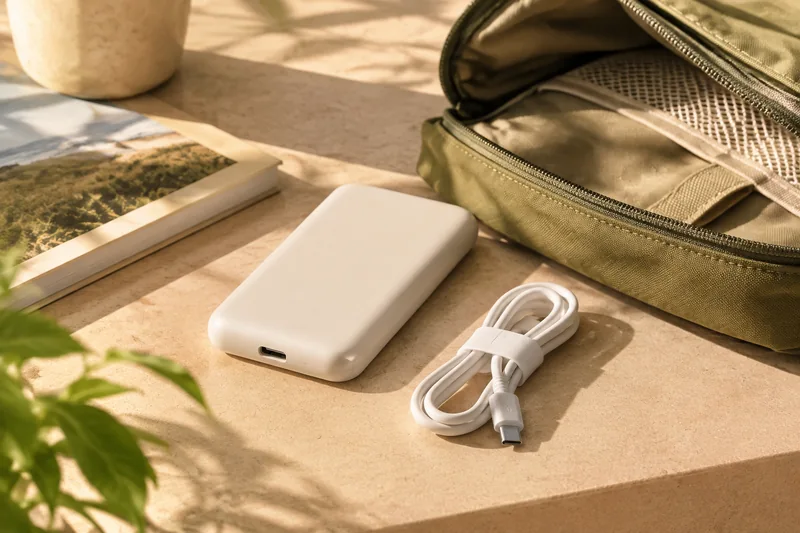
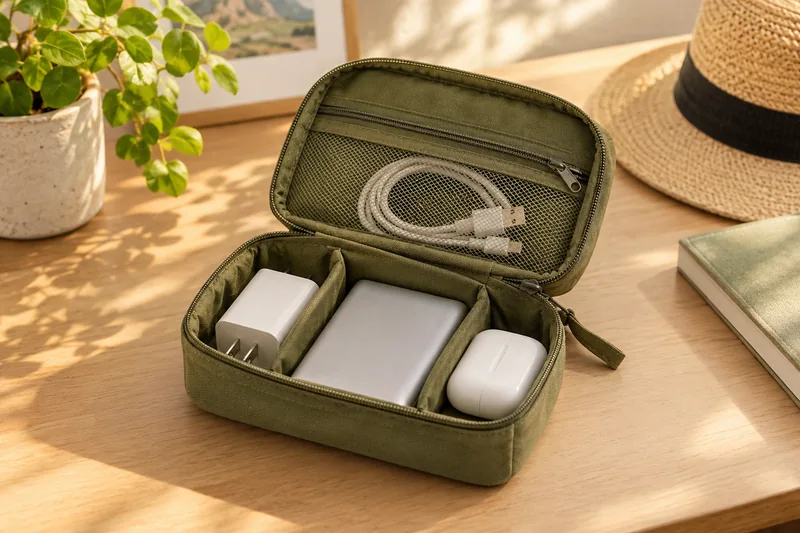
A useful travel tech pouch contains the connections you need for the devices you are actually taking. It is not a small drawer for every cable collected at home. Begin with the device list, then work out which cables, chargers and accessories serve it.
Keep safety decisions separate from organisation. Putting a power bank in a tidy pouch does not establish that it is permitted on your flight. Check its specifications, your airline’s current conditions and the relevant aviation guidance.
Map the connections
For each device, note the charging connector and the charger it needs. Check compatibility using the actual device and charger information. A cable fitting a socket is not by itself proof that every charging feature or power requirement is supported.
Test the combination before travel. Charge the phone, headphones or laptop with the kit you intend to pack. If you are relying on one charger for several devices, confirm the manufacturer’s supported use rather than assuming all ports work identically in every combination.
Keep the genuinely necessary pieces
An example compact setup might include a charger, the appropriate cable or cables, headphones and a power bank that you have verified for the journey. A work trip may also need an adapter for a presentation or a specific peripheral. Those are examples of functions, not an instruction to buy a particular number of accessories.
Remove obsolete adapters and duplicate cables that do not solve a real need. Keep a deliberate spare if a failed connection would materially disrupt the trip and there is no practical alternative. The aim is considered redundancy, not eliminating every backup.
Choose a pouch that suits the kit
Lay the items together before choosing a case. A rigid organiser with many empty loops may be larger than the actual contents need. A soft pouch can be lighter but may offer less protection. Pick the appropriate balance for your equipment.
Coil cables without forcing tight bends, keep sharp accessories away from delicate items and make frequently needed connections easy to retrieve. Leave devices and batteries protected according to their manufacturers’ instructions and the applicable travel rules.
Prepare for screening and gate changes
GOV.UK advises making sure electronic devices are charged; a device that cannot switch on when requested may not be allowed onto the aircraft under that guidance. Check current departure instructions and keep any items staff need to inspect accessible.
The FAA’s spare-battery guidance explains that spare lithium batteries, including power banks, belong in carry-on baggage and need protection against short circuits. Read the live guidance and airline conditions for capacity and quantity limits. If the larger bag is moved to the hold, you need to be able to remove those items rather than discover them after handover.
Consider your accommodation and destination
Check the electrical connection requirements for your actual destinations. A plug adapter and a voltage converter perform different jobs; do not assume an adapter makes every appliance electrically compatible. Read the device rating and seek appropriate advice if you are unsure.
Once packed, use the pouch for a normal day at home. Anything repeatedly missing belongs on the list. Anything you never need deserves another look. That small rehearsal can reveal a better travel setup without buying a larger organiser.
Read power banks on planes for the source-based safety checklist behind the packing decision.