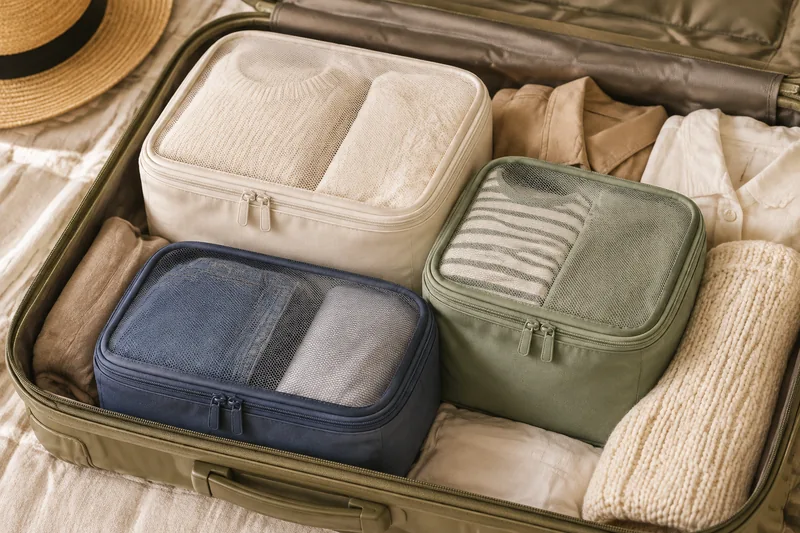
Packing cubes are most useful when they solve an organisation problem. They can separate clothing groups, make a bag easier to unpack and keep small items together. They do not reduce the weight of the things inside them, and additional fabric and zips become part of your load.
If you already find everything easily in your bag, a large set may add little. If opening your luggage means emptying a heap of clothes onto the floor, a simple division can make the experience more manageable.
Decide what you need to separate
Think about when you will open the bag. On a short trip with one accommodation stop, an organiser for underwear and socks might be enough. On a journey with several stops, separate cubes can let you retrieve one outfit without disturbing the rest.
Choose categories that make sense to you: tops and bottoms, clean and used clothing, or daytime and evening items. There is no requirement to put every object into a cube. A jacket needed during the journey is often better left accessible rather than zipped into an otherwise neat system.
Understand compression honestly
Some organisers use a second zip to compress soft clothing. This can change the shape of a bundle, but it does not make its contents lighter. Densely packed clothing can also make a bag more awkward to handle or push its total weight beyond an applicable allowance.
Do not use compression as permission to bring more than you need. First remove duplicate items. Then see whether modest compression helps your existing list fit a practical shape. Always measure and weigh the packed result, not the empty organiser.
Start with a small trial
Use a lightweight pouch you already own to test the idea. Pack the same clothes with and without it. Check whether you gain useful access, whether the bag closes naturally and whether the organiser creates unused gaps around its edges.
| Question | A useful result |
|---|---|
| Can you identify the contents quickly? | You do not need to open every pouch |
| Does it fit the bag’s shape? | Corners and narrow spaces remain usable |
| Is the zip easy to close? | The fabric is not under obvious strain |
| Does unpacking become simpler? | You can retrieve the needed group without emptying everything |
A matching set designed for a different suitcase shape may be less practical than two simple pouches that fit yours. Avoid letting the available cube sizes dictate how many clothes you bring.
Give worn clothes a separate route
Decide where used clothing goes before the trip begins. An empty lightweight laundry pouch can keep it away from clean garments. A packing cube is not automatically a leakproof or odourproof container, so check the actual material and construction rather than assuming every zip bag performs the same job.
Do not leave damp clothing sealed into a travel bag longer than necessary. Follow the clothing’s care instructions and the accommodation’s rules when washing or drying. See the travel laundry routine for a simple planning method.
Buy only after the trial reveals a need
Look at weight, shape, zip access and whether the contents are visible or clearly distinguishable. Durability claims and washability should be checked against the specific product. We are describing a method here, not reporting a test of any particular brand.
The broader principle is to keep the list under control before improving the container. OneBag’s packing approach similarly begins with a considered packing list. If the cube makes that list easier to use, it has earned its place. If it only allows another layer of unused clothes, edit the contents first.